.png)

The Forgotten + Free Historical HAIR GROWTH Secret Everyone Ignores

Okay, I haven't seen anybody talk about this.
Victorian ladies and frankly, ladies in many other eras and cultures, grew their hair down to their knees and beyond, while so many people today struggle to even get their hair to waist length. And in all of our focus on how to grow long hair, we are forgetting the most simple and actually free hair growth secret: and that is how we wear and style our hair day to day.

Because Those historical ladies with the super long hair? They barely ever wore their hair down like we do on most days as modern people. They kept it pinned up, braided, twisted, and tucked away nearly every single day of their lives.

So if you want long hair, this video is for you. We are going to learn about how the way you style your hair can make or break your hair growth journey, what a true protective style is, and show how to make any hair style protective of your hair and an aid to growing it long and healthy.
What Historical Hair Care Can Teach Modern People
Each period of time has strengths and its weakness. Modern hair care has a lot of benefits going for it, including highly innovative products that can help keep the scalp cleansed and the hair conditioned and easy to detangle. That said, our modern culture’s hair care practices are based on a few assumptions: 1) that extreme scalp and hair cleanliness is the most important thing and 2) that due to current fashion, most people will not choose to grow their hair longer than rib-cage length.
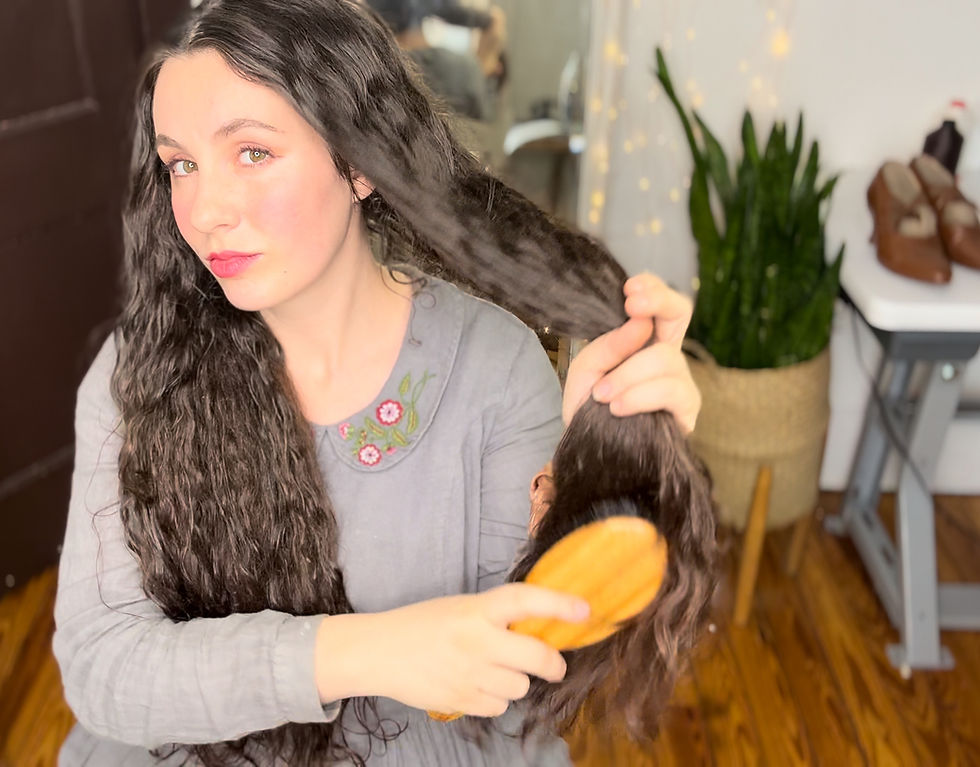
Effectively, this means that our modern hair care practices, while they can be highly effective in certain important areas, like scalp cleanliness, may have large blind spots when it comes to the needs of those who wish to grow longer hair.
But what are those needs?
The Biggest Secret to Growing Long Healthy Hair
The biggest secret to hair growth is not actually…hair growth. It’s length retention. What is length retention? Hair growth is a combination of two factors - the speed at which your hair grows from your scalp, combined with how much of that length you are able to retain on your head without it breaking off. Most people’s hair is always growing, and while we can do things to speed this up, this will be totally irrelevant if you are breaking your hair ends off faster than you are growing it.
So while it may not seem nearly as exciting as boosting hair growth, length retention is the biggest blind spot and therefore, the hidden key which can help your hair grow longer than ever - with just a few simple changes.
Length retention simply means keeping the hair that has already grown out of your head as healthy and damage free as possible, for as long as possible, by limiting breakage.
Growing long hair is mostly about caring for the health of the hairs already grown, and protecting the ends from breakage.
So much of this is affected by how we style and wear our hair on a regular basis. And the longer your hair becomes, the more important this is.
Historical women in most cultures and eras tended to wear their hair up each day, or at least in braids. This was done for a number of practical, societal and even religious reasons, but regardless of the reason, the result was that this was likely a huge factor in how so many historical ladies could grow their hair so long.
What was the secret? These styles were actually protective hair styles. Let’s break down what this means.
What Is a Protective Hair Style?

A protective hair style is one which keeps the hair ends tucked away, protected from friction, mechanical damage, and the elements, thereby keeping the fragile hair ends as conditioned and healthy as possible. Remember that hair strands cannot repair themselves, so the best way to keep them healthy is to simply prevent damage from occurring in the first place.
One more important aspect of a protective hair style that we see in most historical updo’s is that they evenly distributed the weight of the hair across a larger surface area, as opposed to a tight modern ponytail or bun. This helps prevent excess tension that can cause traction alopecia - hair loss via pulling.

Now, I know what you are wondering…
Does this mean I can never wear my hair down?
Of course not! It’s all about finding a balance that works for you and your hair goals. Some people love wearing their hair down, and that’s fine. I would simply suggest that you should not always wear your hair down, and perhaps when you get home, put it in a gentle protective style, or wrap it up in a silk scarf.

Protecting your hair is especially important if you are going to outside in very hot, sunny, and dry weather, or very cold weather.
Now, what are some real life examples of protective styles?
Let’s talk about that now.
Protective Hair Style Examples
Finding the protective style that works for you is more of an art than a science. Just keep in mind that you want to have the hair ends tucked away, and the weight of your hair as evenly distributed as possible.
To keep it simple, I will give three basic examples of easy protective styles that can work for different hair lengths. I will not go into detail here on how to create these styles. I do have another article from a few years ago showing several different styles, and I plan on releasing another article on protective hair styles in the near future if enough of you are interested.
The first protective style is a simple bun, of which there are so many variations. Remember that you want to create your bun by twisting the hair into a coil and either pinning or using hair sticks or even a claw clip, not just using a modern hair elastic. A bun made with just an elastic will put too much tension on that small area of your scalp.

The next style is a French twist, which scoops up the hair into a vertical “roll” at the back of your head, and looks very elegant.

And finally, milkmaid braids, which believe it or not, can work for hair as short as collar bone length if done properly.

Finally, a semi protective style is a simple braid. I often have braids in my hair when I am at home, or if I want to enjoy the length of my hair without it being completely in my way. One or two braids are also a wonderful way to wear your hair at night, especially combined with a silk or satin bonnet or a silk or satin pillowcase.
But before you begin with protective styles, there are a few important points of warning you need to know!

Important Caveats
Before you begin protective styling, I am going to share some things I wish I had known before I started.
Sometimes with hair care we need to prioritize what is most important to us at any given time. Certain hair goals can, to an extent, be in conflict with each other. For example, if you are currently dealing with active hair shedding, then you need to prioritize scalp health over length retention for now. And this may actually mean keeping your hair loose or simply in a braid, to allow for more breathability around your scalp. If your scalp isn’t able to breathe, this can breed the growth of bacteria and fungus which exacerbates hair shedding. Likewise, even if you aren’t dealing with hair shedding and love wearing your hair in protective hair styles like a bun, always take your hair down in the evening and give your scalp some time to breathe and relax, tension free.
Never, ever put your hair in a protective style if it is wet. Your hair and scalp should be allowed to dry FULLY before being put into any kind of style, because if you trap moisture in your scalp this will create major scalp problems that can lead to hair loss.
Learn how to create protective styles that don’t pull on your scalp, before beginning a routine of protective styling. Otherwise, you can create traction alopecia, which is lost hair due to pulling, that can be very difficult to regrow. I would alway prioritize scalp health over length retention.
Let me know if you have ever tried protective styles before - knowingly or unknowingly, and how your hair responded. Let me know if this helped you and if it is something you want to try!


Comments