.png)

Why Skinny Culture Is Making Your Hair Fall Out

My hair has started falling out in a scary, massive way on two separate occasions within the past two years. In this article I will be sharing with you the results of my own frantic search for answers. Because while this was a highly unpleasant thing to happen to me, the lessons about how health and eating choices can affect hair have been invaluable for understanding hair loss causes and shedding from dieting.
Don’t worry, I will share the entire story later in the article. But today, we will be blowing the cover off why modern skinny culture is making your hair fall out. Furthermore, this information may just be the hidden key to avoiding so-called “age-related hair thinning” and intermittent fasting hair loss that so many seem to believe is inevitable.

Not only that, but we will explore the connection between our hair health, our weight, how much we eat, calories, carbs, Ozempic hair loss, and more. We will also uncover a long-forgotten scientific experiment done in the 1940s — the Minnesota Starvation Experiment and hair loss — that gives us so many answers about why hair shedding happens.
Because we’ve been sold a lie about food and our bodies, and are now reaping the whirlwind of hair problems as a result.
This article is not for you if you believe that hair thinning is completely fated for us by our genetics or hormones, and you are happy to have thin, unhealthy hair, as long as you’re skinny. Jokes
This article is for you if:
You are currently experiencing unexplained hair shedding and want answers
You want to explore whether hair thinning is really an inevitable result of aging
You are interested in the connection between nourishment and our hair
Or if you’re just ready to question what we’ve been sold about carbs being evil and intermittent fasting hair loss
Today we will be uncovering how skinny culture may just be the toxic piece of the puzzle that so many women and men today — and no, not just “skinny” ones — are literally losing their hair over.
Why Skinny Culture Is Stealing Your Hair
Here’s why this matters right now. We’re living through a silent epidemic: we’re seeing hair loss and thinning at levels our grandparents likely never saw. At the exact same time, we’re drowning in so-called “skinny culture” — and yes, this is true whether we ourselves are “skinny” or not.
What I mean by this is that there is a relentless pressure to be smaller, leaner, more “disciplined,” and essentially, to take up less space. Ozempic shots are being normalized and celebrated, there are 1200-calorie eating challenges, and before-and-afters that celebrate rapid weight loss at any cost. Apparently, this feels like progress — and I myself fell for it to some degree. Because of course, no one wants to be overweight, and we know it isn’t healthy. But skinny culture isn’t the answer.
And skinny culture is charging your body a hidden price. So let’s break this down simply.
Diets and over-exercising create real physiological stress in your body, which is hard-wired for survival. When your body senses stress or famine, it goes into survival mode. It prioritizes your heart, brain, lungs, and vital organs — the things you need to stay alive.
But hair? That’s a luxury. It’s the first thing your body is willing to let go of when energy is scarce. Not to mention that dieting and over-exercising truly raise cortisol levels in your body — i.e. the stress hormone — and downregulate your thyroid hormones. This has a number of potentially nasty effects, including the potential for massive hair problems related to thyroid hair loss.
A 2021–2024 systematic review of studies confirms that calorie restriction and intermittent fasting significantly lower T3 thyroid hormone levels. And again, this isn’t just happening to “skinny” people chasing runway looks. Everyone in our culture feels it. Whether you’re a size 0 influencer or carrying extra weight, the constant messaging of “eat less, move more, take up less space” trains your mind and body to undereat relative to what you actually need. The result is a slowed metabolism, protective shutdown, and potentially hair that starts falling out in handfuls when you least expect it.
Ozempic and the Popularization of Hair Loss
Ozempic has supercharged the problem. In clinical trials, about 3-4% of users reported hair loss. In the real world, dermatologists are seeing 25-33% of users experience noticeable shedding. This matches 2025 meta-analyses and cohort studies showing semaglutide users face a 3.4x higher risk of hair loss. Why? Rapid weight loss mimics starvation — it creates metabolic stress that tells your hair follicles: “Now is not the time for growth.”
I am pointing this out not because I think you may be on Ozempic, although it is certainly becoming more common, but because these results on hair from Ozempic simply give us an exaggerated, expedited picture of what the “weight loss at all costs” approach does to our hair in cases of Ozempic hair loss and dieting-related shedding.
This article will be staying at the big-picture level: our relationship with food, our bodies, and modern beauty standards, and how they affect hair health and hair loss causes. I’m not a doctor — I’m just a hair care creator who lost this much hair and went down the rabbit hole. If you want a follow-up sharing my personal sustainable approach (based on my everyday research and experience only), let me know in the comments.
Now… let’s tell the story of how a hair-obsessed creator lost piles of her own hair — and finally uncovered the shocking connections between nourishment, metabolism, and the hair we all want.
The Forgotten Beauty Standard
I don’t know if you’ve ever noticed something about historical women in photos and paintings, but I certainly have. Compared to the beauty icons of today, beautiful women of the past were what many today would call “chubby.” Plump arms were considered lovely and enticing, and a round tummy was a beautiful symbol of femininity. And let’s not forget the long, thick hair that seemed to be so common in these time periods, seemingly flowing with vitality and health. It was the look of being healthy, well-fed and radiant.
Even up to the 1950s with beauty icons like Marilyn Monroe or Sophia Loren, femininity, allure, and status were symbolized by having curves, and frankly, having a more well-covered body. In fact, I recently found ads from around this time period, the 1950s, advertising a product called “Wate On” that would literally help women to gain weight, and apparently in doing so, gain the body, life, and man of their dreams that were apparently being held at bay by their being “too skinny.”

Obviously there are big problems with this kind of advertising, and the product in question was mainly made of sugar and vegetable oils, but still, it shows how radically beauty standards of the body have shifted in very recent history. And the main thing we need to keep in mind is that we are only just starting to see the effects on our health, and yes, our hair, of this widespread, modern “skinny culture” and its impact on hair loss causes.
Metabolism and Hair Growth
Let’s talk about metabolism, because unknown to most, it is deeply intertwined with the health of our hair. Most people view metabolism as simply defining how quickly you burn through the food you eat, or how skinny you are. But metabolism actually powers everything in your body — including how fast, how thick, and how well your hair grows.
Metabolism is the process by which your body takes the food you eat and turns it into usable energy for every cell. And believe it or not, the very things people do to lose weight — like dieting, fasting, or over-exercising — can slow down the metabolism even more, as the body attempts to save energy, and thereby can worsen their weight problem long term, in addition to causing a host of other nasty effects including hair shedding from dieting.
Your hair is especially sensitive to this because your body sees it as a “nice-to-have,” not a must-have. When energy is limited, vital organs come first. Hair is the first budget cut.
Think of metabolism like your bank account. If you have a good income, you can spend more freely and still have reserves. But if you lose your job? You cut non-essentials immediately. Your body does the same with energy. If you eat less to lose weight? You might drop pounds short-term… but your body also dials down the conversion of food to energy. And the very first thing it cuts from the budget? Is your hair.
That’s why so many popular approaches — intermittent fasting, low-carb extremes, “eat less, move more” — backfire for hair health. Your body interprets them as danger, not discipline.
A 2024 study demonstrated that intermittent fasting triggers hair follicle stem cell death and slows hair regeneration in animal models.
So how did we go from a historical beauty ideal that celebrated being well-fed, to our current world of celebrating the famine victim look?
How Skinny Aesthetic Arrived and Changed Hair Forever
Let’s talk about the 1920s, because this is where everything began to change. Much of the world had just lived through a gruesome war, the likes of which no one had ever seen before, and it transformed all aspects of society.

New innovations were coming on the scene. Jazz filled the air, and suddenly the beauty ideal became the boyish, slim flapper look. Basically, this look celebrated a straight, boyish figure with flattened curves. Corsets were still present, but shaped to actually compress women’s natural curves. Hemlines were coming up, and women were essentially being told to take up as little space as possible. But it felt exciting. It felt like freedom. But “freedom” had a hidden cost.
Skinny’s Hidden Cost to Your Hair
For the first time on a big scale, women started deliberately restricting calories to chase that sleek look. In 1918, Dr. Lulu Hunt Peters released the first big calorie-counting bestseller, and the trend exploded right into the 1920s.
Daily intakes that used to keep a woman’s metabolism strong started dropping lower and lower. And here’s the “coincidence”: hair fashion changed at the exact same time.
For centuries, long, thick, cascading locks were the symbol of health and femininity. Then suddenly the bob was everywhere — short, sleek, boyish hair cuts.
F. Scott Fitzgerald even wrote a whole story about a girl getting her hair bobbed. It looked modern and practical… but those short styles also conveniently hid the hair thinning and shedding that was beginning as metabolism slowed and the body started treating hair as non-essential.
We thought we were breaking free, but instead we traded one set of chains for another — one that shrank both our bodies and our vitality. And we’re still paying the price today.
The Inequality of “Arbitrary” Beauty Standards
Now, I know an inevitable comment is going to come up: But Katherine, “Beauty standards are simply based on what a society collectively decides is most unattainable. So in history, it was more unattainable to be well fed and well nourished, so they found a chubbier body type more attractive. In our society, for a bunch of reasons, it’s more unattainable to be thin and muscularly toned, so we have declared that to be the most beautiful body type.”
I would agree with all this. Beauty standards can be seemingly arbitrary — based on that which is most difficult to attain in a given culture and time period. But here’s the thing — beauty standards may be arbitrary, but they are not equal. Skinny aesthetic may just be an arbitrary beauty standard based on the culture we live in, but it is objectively less healthy for our bodies than a beauty standard that reveres fed, well-nourished looking bodies.
So now let’s talk about my own experience involving massive hair shedding, the dark side of intermittent fasting, and the delicate play between our hormones, our weight, and our hair.
My Hair Shedding Story
Over the past couple of years, I lived this hair shedding story twice. About six years ago I got into 16-8 intermittent fasting. I had a baby during that time and my postpartum shedding was the worst it had been up until that point. But I had no idea what was coming later… Then I tried pro-metabolic eating, but only at a surface level and with very little research put in.
My hair became fantastic during that time, but I gained a ton of weight. After a year and a half I panicked and went back to what I knew — just a little intermittent fasting to lose the weight. My hair started coming out in handfuls. I stopped and the hair loss stabilized.
Fast forward to after my newest baby last October. I went all-in on weight loss while breastfeeding, as I had been almost 20 pounds overweight for a few years by that point. Hardcore strength workouts on an empty stomach, busy days, and very delayed breakfasts. There was this quiet little voice the whole time whispering, “You’re undereating. You need more.” I ignored it. I got angry at it. I wanted the scale to move more than I wanted my hair, it would seem.
The shedding got fairly terrifying — including massive hair piles and cry sessions while detangling at night. While some hair shedding is normal postpartum due to hormonal changes, this time around was far worse than any of my other postpartums. The main difference this time around was the rapid, intentional weight loss and hair shedding from dieting.
I finally realized that I would choose healthy, thick hair over being “skinny” any day. That’s when I started digging frantically. I found studies on intermittent fasting and hair loss in rats and mice. I finally admitted I’d been undereating by about 1,000 calories a day.
Now I’m learning to increase food gradually as my metabolism wakes back up. My hair is recovering, my weight is remaining stable, and I feel better than I have in years. That’s the story I wish I’d known sooner — and the one I’m sharing with you today so you don’t have to learn it the hard way.


Now we need to talk about a little-known scientific experiment from 1944 and its shocking relevance to modern skinny culture and hair loss.
The Minnesota Starvation Experiment
It’s 1944. Thirty-six healthy young men sign up for a study in Minnesota to help starving people in war-torn Europe. At first they ate about 3,200 calories a day — what their bodies actually needed. Then the researchers cut their food in half to roughly 1,500 calories.
Over the next six months they lost around 25% of their body weight. Their metabolisms dropped by up to 40%. And many of them started losing large amounts of hair. The Minnesota Starvation Experiment by Keys et al. documented that 1,570 calories per day caused significant hair loss and up to a 40% drop in metabolic rate.
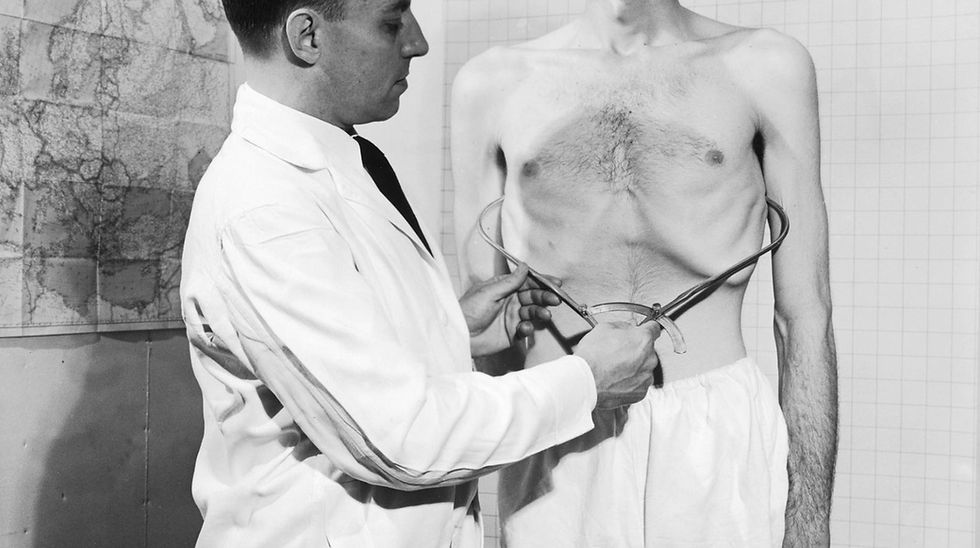
Their bodies were doing exactly what bodies do under stress — protecting the vital organs and letting go of anything extra. Hair was one of the first things to go.
Now here’s what should stop you in your tracks: 1,500 calories was considered semi-starvation in the 1940s. Today that same number is pushed as a normal, healthy calorie target on so many diets.

But our bodies still need the same things. When energy gets too low for too long, our body reacts the same way those men did. It puts hair on the “non-essential” list.
This study is the proof behind so much of what we’re seeing with skinny culture and hair loss causes.
But what’s the hopeful part? When the men in this starvation experiment finally got enough food again, their bodies and their hair started to recover. Yours can too.
Calories In, Calories Out & the Thyroid Dimmer Switch
Here’s where the simple “eat less, move more” story really falls apart — and it explains so much about my own hair shedding experiences.
Studies show something surprising: many obese people are actually eating less and exercising more than naturally lean people, yet still struggling with their weight. Their bodies have essentially adapted by slowing everything down. It’s not a willpower problem — it’s a metabolic one. A classic example is a 1992 study on so-called “diet-resistant” obese individuals.
And do you remember the show The Biggest Loser? Those contestants lost huge amounts of weight through extreme restriction and exercise. But just a little while later, many of them had gained it all back, according to a 2016 follow-up study. And years later, their metabolisms were still suppressed by hundreds of calories a day. Their bodies had simply turned the energy dial way down to survive.
Let’s talk about the thyroid. Your thyroid is intimately connected with how fast, thick, and healthy your hair grows. But your thyroid isn’t an on/off switch — it’s more like a dimmer. Chronic dieting, big deficits, and even intermittent fasting can quietly turn that dimmer switch way down, lowering thyroid hormones and nudging you toward a hypothyroid state. That means slowed metabolism, reduced energy, and yes — increased hair shedding and thyroid hair loss.
During my most recent bout of weight loss, that’s exactly what was happening. No wonder my hair was coming out in handfuls.
Constant famine signals mean hair (that non-essential extra) gets deprioritized first.
What Is “Enough” Food for Healthy Hair?
Believe it or not, people used to eat so many more calories in the past. In the 1950s, for example, the average woman was taking in around 2,800 to 3,000 calories a day — nearly a thousand more than most women are told is “normal” today. USDA historical data confirms women in the 1950s averaged approximately 2,800–3,000 calories daily. Now of course, these calories were likely of a higher quality than those commonly eaten today, which does make a difference, but that is out of the scope of this article.

And it’s not just the 1950s. Back as far as the late 1800s, when scientists were just beginning to measure food in terms of calories, they had massively higher caloric recommendations for people than what we see today. I would offer that this is because firstly, the food back then was of a much higher quality and people’s metabolisms were much higher, and they also recognized that you get out what you put in, so to speak.
There’s even a study on chess players at tournaments that shows how high our caloric needs really can be. Even though these chess players were sitting still, the intense mental focus and stress ramped up their energy demands dramatically — some estimates put it as high as 6,000 calories a day. That is nearly 3 times more than what many people are eating today. It proves your body needs real fuel just to think and function, even without physical exercise.
Over time, due to dieting culture, changing food availability, and lower recommendations, the amount of calories and nutrients we’re taking in on average has slowly gone down. At the same time, average weight has gone up. What’s happening? Our metabolisms have basically down-regulated to adapt. Translation: this means way less energy availability for our hair growth.
So-Called “Inevitable” Mid-Life Hair Loss
This makes me wonder about something big. How much of modern-day hair loss that we’ve all accepted as normal is simply a reflection of these slow metabolisms and low thyroid function? And what about mid-life hair loss for example?
So many women in their forties, fifties, or sixties start shedding and label it as “inevitable” due to hormone shifts. But how much of it could actually be the body finally saying “enough”?
After decades of under-eating relative to what it truly needs, perhaps the body has simply had enough. It down-regulates the thyroid and metabolism even further to protect the vital organs, and the hair starts falling out as the ultimate non-essential.
But what is the hopeful part? Once we understand this, we can start nourishing in a way that gently turns that dimmer switch back up — before the body reaches that final “enough” point.
Eating for Cell Energy and Your Hair
Here’s something that completely flipped the script for me — and it might be the missing piece for you too. Your cells do not run on willpower. They run on glucose. And glucose comes from carbs. Your body is literally designed to burn glucose for energy. Every cell — especially the ones powering hair growth — prefers this clean, fast fuel. When we limit or cut carbs completely, we make it so much harder for our body to get the energy it needs. Yes, we will still survive, but it puts way more stress on our liver and will seriously down-regulate our thyroid function.
And a low functioning thyroid goes hand in hand with massive hair shedding potential. I learned this the hard way.
When I was recently trying and succeeding to lose weight, I was doing it in what seemed like the easiest, most effective way. I started eating way fewer carbs, in addition to intermittent fasting. My hair started falling out like crazy right around the time I started doing this.
That’s the hidden conflict. Skinny culture, and even the alternative world of healthy eating, tells us that carbs are the enemy — and that avoiding them makes us healthy and beautiful. So why not cut them out completely?

But underneath, our cells are struggling. Low carbs force your body to make glucose the slow, stressful way. It dials down non-essentials… like hair. Because hair is still that “nice extra.” When I finally started adding back real carbs recently — mostly through fruit, root vegetables, rice, and sourdough bread — and timed earlier in the day, my energy returned, and my hair shedding slowed. Baby hairs started showing up and still are.
So carbs aren’t the villain we were told they were. They’re the steady wood that keeps the inner fire burning so your body can grow beautiful hair.
Warning — Don’t Make This Mistake!
If you are freaking out right now and wondering if you have been undereating for years and it is causing you hair problems, please do not panic. Remember, sudden changes are stressful for your body, even if they are changes in the right direction. I also want to leave a note for those of you who, like me, have been eating a paleo or Weston A. Price inspired diet that is very high fat and relatively low carb.
If you are hearing this and thinking you need to increase carbs, please do so gradually, and keep in mind that a diet that is both high in fat AND carbs is a recipe for weight gain. It is way beyond the scope of this article to give specific dietary advice, so I will link an extremely helpful Substack in the description that I have been learning so much from myself.
Conclusion
We’ve covered a lot today — from the forgotten beauty standard of well-nourished women with thick, vibrant hair, to the 1920s shift that slowed our metabolisms, the Minnesota Starvation Experiment and hair loss, the calories-in-calories-out fallacy, the thyroid dimmer switch, and why carbs are actually important fuel for stopping hair shedding from dieting.
The main point is simple: when we don’t eat enough for our real needs — through chronic dieting, fasting, over-exercising, or cutting carbs too low — our bodies protect the vital organs and drop the non-essentials. And hair is one of the first things to go.
I used to think my episodes of massive shedding were just bad luck or hormones. But now I see it was my body saying it didn’t have enough energy to keep everything running.
But what’s the hopeful part? Our bodies are resilient. When we start nourishing them properly and gently, the metabolism wakes up, the thyroid turns back up, and our hair becomes revitalized.
I’m living proof. My hair is recovering and I feel better than I have in years. You don’t have to accept thinning as “unavoidable aging.” There’s another way.
If this resonated, let me know in the comments! Thank you for reading and I’ll see you next time.
Frequently Asked Questions
Q: Why is my hair falling out after dieting or weight loss?
A: Hair shedding often occurs because calorie restriction and rapid weight loss signal famine to your body. It prioritizes vital organs and drops non-essentials like hair growth. This is common with approaches like intermittent fasting, extreme deficits, or cutting carbs. Increasing nourishment gradually can help reverse it.
Q: Does intermittent fasting cause hair loss?
A: Yes, intermittent fasting and other forms of calorie restriction can trigger hair shedding. Studies, including animal models, show it leads to follicle stem cell issues and slowed regeneration. It also lowers thyroid hormones (especially T3), which are critical for hair health. Many experience worsening shedding during or after IF.
Q: Is Ozempic or semaglutide causing my hair loss?
A: Ozempic and similar drugs are linked to higher hair loss rates (3.4x risk in some studies), with real-world reports from 25-33% of users. Rapid weight loss mimics starvation stress on the body. Even without the drug, the “weight loss at all costs” mindset produces similar effects on hair.
Q: Can “skinny culture” really make your hair fall out?
A: Absolutely. The constant pressure to undereat, over-exercise, or stay small slows metabolism, raises cortisol, and downregulates thyroid function. Hair is one of the first things your body sacrifices for survival. Historical shifts toward slim ideals coincided with increased short hair trends that hid thinning.
Q: What does the Minnesota Starvation Experiment teach us about hair loss?
A: In the 1944 study, men on ~1,570 calories per day (considered semi-starvation) lost significant hair and saw up to 40% metabolic slowdown. Today, similar calorie levels are promoted as normal diets. The good news: hair and metabolism recovered with proper refeeding.
Q: How does thyroid function affect hair growth?
A: Your thyroid acts like a dimmer switch for metabolism and energy. Chronic dieting turns it down, leading to low thyroid hormones, fatigue, and increased shedding. Supporting metabolism through adequate calories and nutrients helps turn the dimmer back up for thicker, healthier hair.
Q: Do I need more carbs for healthy hair?
A: Yes — carbs provide glucose, the preferred fuel for cells including hair follicles. Low-carb diets force stressful alternative pathways and further suppress thyroid function. Adding quality carbs (fruit, rice, potatoes, sourdough) earlier in the day helped stabilize my shedding and promote baby hair regrowth.
Q: How many calories do I need to stop hair shedding?
A: Needs vary, but historical data shows women in the 1950s averaged 2,800–3,000 calories daily with stronger metabolisms and better hair. Listen to your body — many undereat by 800–1,000+ calories. Increase food gradually while supporting thyroid and avoiding sudden changes.
Q: Is mid-life or postpartum hair loss inevitable?
A: Not entirely. While hormones play a role, much “age-related” or postpartum thinning is worsened by years of restriction, low metabolism, and under-nourishment. Nourishing properly can reduce severity and support recovery, as seen in my own postpartum experiences.
Q: How can I reverse hair loss from dieting?
A: Focus on gentle re-nourishment: eat enough calories from quality sources, prioritize carbs for energy, support thyroid health, reduce stress, and be patient. Avoid yo-yo restriction. My hair recovered with this approach — baby hairs appeared as my metabolism stabilized. Consistency is key.
Q: What’s the best way to nourish hair naturally?
A: Eat sufficient calories and carbs, manage stress, support metabolism/thyroid, and use gentle hair care (herbal oils, proper detangling, etc.). Reject extreme restriction.


I've tried several IPTV Canada providers over the years, and this has been the best experience so far. The streaming quality is excellent with stable 4K IPTV, thousands of live TV channels, sports, movies, and TV shows. Setup was quick, customer support was responsive, and everything works smoothly on Firestick, Android TV, and Smart TV. If you're looking for the best IPTV Canada, a reliable IPTV subscription Canada, or a high-quality Canadian IPTV service, I definitely recommend giving them a try. Thanks for the great service!
Found this game while searching for casual driving challenges. Drive Mad online is a great way to enjoy short gaming sessions.
I would love to hear about your approach and what information you have found. I enjoyed the article. Thank you for all the work you do
Thank you Katherine! This is wonderful info. I have many family members who practice intermittent fasting and this will be so helpful in the conversation.
Katherine,
I would like to add my own personal experience of hair loss (also fasting and whatnot) and it turning out to also be a very severe underlying iron deficiency. I’ve gone down the crazy rabbit hole with it and medical professionals just don’t take it seriously or even check for it. Having multiple childbirths and having a menstrual cycle puts us at a high risk for iron deficiency plus our food being so nutrient deficient (even intentional eating with the most organic emphasis). Get your iron and vitamin levels checked too!! For the love of women everywhere, spread the word. It was a shock for me and now I am shouting it from the rooftops.